STUFF FOR
HUMANS

Case Study: Assessing the Impact of iOS14 for Koch Comm

The Challenge 

We’re in the business of setting our clients up for continued success, so when something throws a wrench in their data measurement and reporting processes, we’re the first ones to notice. The wrench in this scenario: iOS14.5.  

Apple’s latest update brings with it a host of data collection restrictions that promise to throw digital marketers for a loop, impacting their ability to collect third-party user information. We knew the first step to helping our clients overcome this hurdle would be to assess the update’s potential impact on their marketing efforts so they could make educated strategy decisions moving forward.  

That’s exactly what we did for Koch Comm, a digital, public relations and creative agency located in Oklahoma City. 

The Process 

To assess how iOS14 could impact the 24 Koch Comm clients we provide reporting for, we started by reviewing their Facebook and Instagram advertising data. By identifying the campaigns whose objectives were reliant on third-party user information, we isolated the ad sets that could potentially be affected by iOS14’s data collection restrictions.  

Next, we analyzed their Facebook and Instagram audiences by device and operating system. This revealed the proportion of users within clients’ engaged audiences that were using iOS devices according to Facebook Business Manager.  

Our final step was to use Google Analytics to conduct a robust assessment of the client’s website users’ activity. Using the Browser & OS report combined with source and medium as secondary dimensions, we generated a full breakdown of the operating systems being used by each client’s Facebook and Instagram audiences.  

With that filter in place, we could then see how iOS users were interacting with the clients’ websites, providing essential insights into how strategies may need to be adjusted. For example, if a client’s Facebook iOS audience engagement metrics (such as time on site and pages per session) were high, that would indicate that the paid media team would need to strategize an effective way to reach them that wouldn’t rely on pixels.  

The Results  

Analyzing Koch Comm’s digital advertising through the lenses above laid the foundation for us to create comprehensive dashboards that unified their iOS-affected data, both past and present, enabling them to clearly see how their marketing efforts are presently being impacted by iOS14.  

With individualized visualizations for each client, we created an analytics infrastructure that will enable Koch Comm’s digital marketers to derive key insights and adjust their strategies as necessary moving forward.   

Once those dashboards were built, we consulted with Koch Comm’s paid media department to determine which ads would need to change based on the data currently available. Knowing that iOS14’s impact is a moving target and that we’d need more data before advising longer term adjustments, we created unique plans for each client to refer to once they start to see its effects. 

The Takeaways 

At the outset of a potential crisis, it’s tempting to give in to a knee jerk reaction, pointing the firehose before seeing the flames. Don’t do it. Yes, iOS14 is going to impact your digital advertising, but the extent of that impact should drive your strategies, not the other way around. If you adjust your advertising tactics before seeing the way iOS14 is affecting your results, you risk muddying your data and harming your marketing efforts more than helping them.   

The moral of the story? Sometimes the best thing to do is to gather all your data and analyze it before moving forward. With the active visualizations we created, the Koch Comm team has everything they need to do just that.  

Need a hand wrangling your data in the wake of iOS14? Let’s chat – schedule a consultation today.   

STUFF FOR
HUMANS

Marketing Budgets are Shrinking. Why You Should Still Invest in Analytics.

Marketers usually have one thing in common – they are looking to preserve and defend their marketing budgets. Implementing a marketing measurement strategy and analytics solution that is sustainable, and offers actionable insights, is critical to achieving this goal.  Available solutions in the marketplace range from plug-and-play tools that require the end-users to manage their own inputs and outputs to full-service intelligence firms (like OROS Analytics) that offer a user-friendly toolin-depth insights and technical expertise in technology and marketing to impact your strategy.   

Budgeting Will Always Be Data Driven

According to the CMO Spend Survey 2019 – 2020 executed by Gartner, “CMOs have staked their claim that competitive insights and analytics are the two most important capabilities supporting the delivery of their marketing strategies over the next 18 months” (Gartner, 2019 – gain access to the full survey). That same survey indicated that 76% of marketing decisions are data-driven and that on average 16% of a company’s overall marketing budget is being ear-marked for data and analytics solutions.

Not All Tools (or Marketing Analysts) are Created Equal

Plug-and-play solutions appear to be the cheaper route in terms of tool investments at first glance, but don’t forget that you’ll still have to invest in an employee to manage that tool.  Some companies are going all in on their investment in marketing analytics and bringing data scientists in house. Glass Door indicates that an investment in an in-house data scientist could range between $83K and $154K annually depending on what part of the country you are in (and don’t forget that their salary does not include the additional investment that will still need to be made in the tools that those scientists are using). And if the tools they are using aren’t allowing them to layer information in a way that is actionable and meaningful – you can chalk your entire investment up to money-well-wasted. In the long run, this solution could cost you double what investing in a partnership with a firm like OROS would cost.  

Plug-and-play solutions also present challenges in terms of layering data and data inclusivity.  If an API connection doesn’t exist, the plug-and-play model immediately falls apart through limitations on what data can be included in your dashboard. These tools are ostracizing measurement strategies meant to include traditional marketing efforts through an emphasis on digital-only channels. These tools also fail to overcome the pain point of layering data. The plug-and-play solutions might help to get all of your data into one dashboard, but that data still exists in independent silos and doesn’t show how one set of data is influencing other data points. The bottom line is this: Tools can help – but they don’t replace the value of real humans, that understand marketing, rolling up their sleeves and getting to know your business.  

Relying on data to make strategic decisions sounds smart, but it can be dangerous if your marketing measurement strategy isn’t thoughtful, all-inclusive and delivered in a tool capable of layering to understand attribution and a true correlation between your marketing efforts and the results that those efforts are driving.  A single dashboard where all of your data exists is one thing – a custom dashboard that shows attribution and the correlation between your ad spend, revenue generation and overall brand health/engagement is another.

What To Consider When Choosing a Marketing Analytics Solution

Here are some things to consider when investigating marketing analytics solutions. If you want someone to walk through these questions with you, let us know. We’d love to help.  

  • Do you have a documented measurement strategy that coincides with your existing marketing calendar and company-wide objectives and KPIs?
  • What does your current reporting look like?
    • Is your team manually creating reports in Excel and Powerpoint, and if so, how many hours a month are they spending building these reports?  
    • Where do your reports live? Are you able to access one report that tells you everything you need to know or are you accessing multiple reports across various platforms, file types and dashboards?  
    • Are you regularly reporting the performance of your marketing efforts and is your method for doing so sustainable long term? (think employee bandwidth, knowledge of various platforms, knowledge of marketing strategy and tool capabilities).   
    • Do you have a team with a technical background that can effectively manage API connections and data dumps? 
    • Are you able to visualize marketing and business data together in a meaningful way? 
  • What systems, efforts and platforms are you using that you could be layering data from?  
    • Platforms to consider:  
      • Google Analytics 
      • Social media platforms 
      • Digital ad platforms 
      • SEO 
      • SEM 
      • Email marketing tools 
      • CRM 
      • Point-of-sale system 
      • Traditional media efforts (tv, billboards, print) 
      • Other proprietary platforms 
  • What data do you wish you could start collecting? Would it be helpful to have a partner that can talk through best practices for data collection?  
  • Do your analysts understand marketing attribution theory and how it applies to your marketing strategy?   
  • Are you currently able to retrieve data from APIs with ease?  
  • Can you easily filter your current reports, and would the following filter types be useful to you?  
    • Date range 
    • Promotion type 
    • Platform 
    • Revenue source 

Consider how you responded to each of the questions in the list above. Maybe the best solution for your organization is evident.

If you’re not sure where to get started or what solution type is best for you, let us help. We would love to set up a consultation to learn more about your existing measurement strategy, talk you through our process and offer some solicited advice.

STUFF FOR
HUMANS

A pandemic necessity: Prove your value by measuring your marketing

Everything must be measured – even in a crisis.

Especially in a crisis.

Measuring your work and your effectiveness makes you better, smarter and more efficient. That’s not ground-breaking. You know that. You believe that. You probably even preach that. 

But it’s often not reality. As marketers, we tend to focus on the immediate need – especially when in a crisis. We’ve said it, we hear people say it… “Proving the value of marketing will happen in the future. We can worry about that later.” 

But a pandemic? Now that’s a crisis that will quickly make you focus only on what’s right in front of you. It will make you forget what proves your value to your business and your client.

Don’t let that happen to you. When you act fast to get the right message to the right people at the right time with the right calls to action, you are vital to a brand’s reputation. You can make or break the preservation of brand equity. Your work can set the stage for positive brand awareness and a successful rebound. 

That’s not just valuable, it’s invaluable. 

SET THE STAGE

Just like you would prepare for crisis management communications, have everything set up and ready for measurement so you can show that value.  Have your UTM structures in place. Connect your data sources. Set the KPIs for each of your primary communication channels. Put your benchmarks in place to empower you with the information you need when the dust settles. 

Know your goals. Measure your work. Tell the data story. 

A CRISIS TEST CASE 

We did that for Koch Communications, a digital marketing agency partner, during the COVID-19 pandemic crisis that landed in its backyard. In Oklahoma, the world changed on March 11, when an NBA basketball game was stopped in Oklahoma City after a player tested positive for the coronavirus. Sports fans remember that as the moment the sports world changed indefinitely. Within hours, the entire NBA season was suspended.

By the next morning, it was clear that everything else was going to change, too – and that affected all of Oklahoma-based Koch Comm’s clients. 

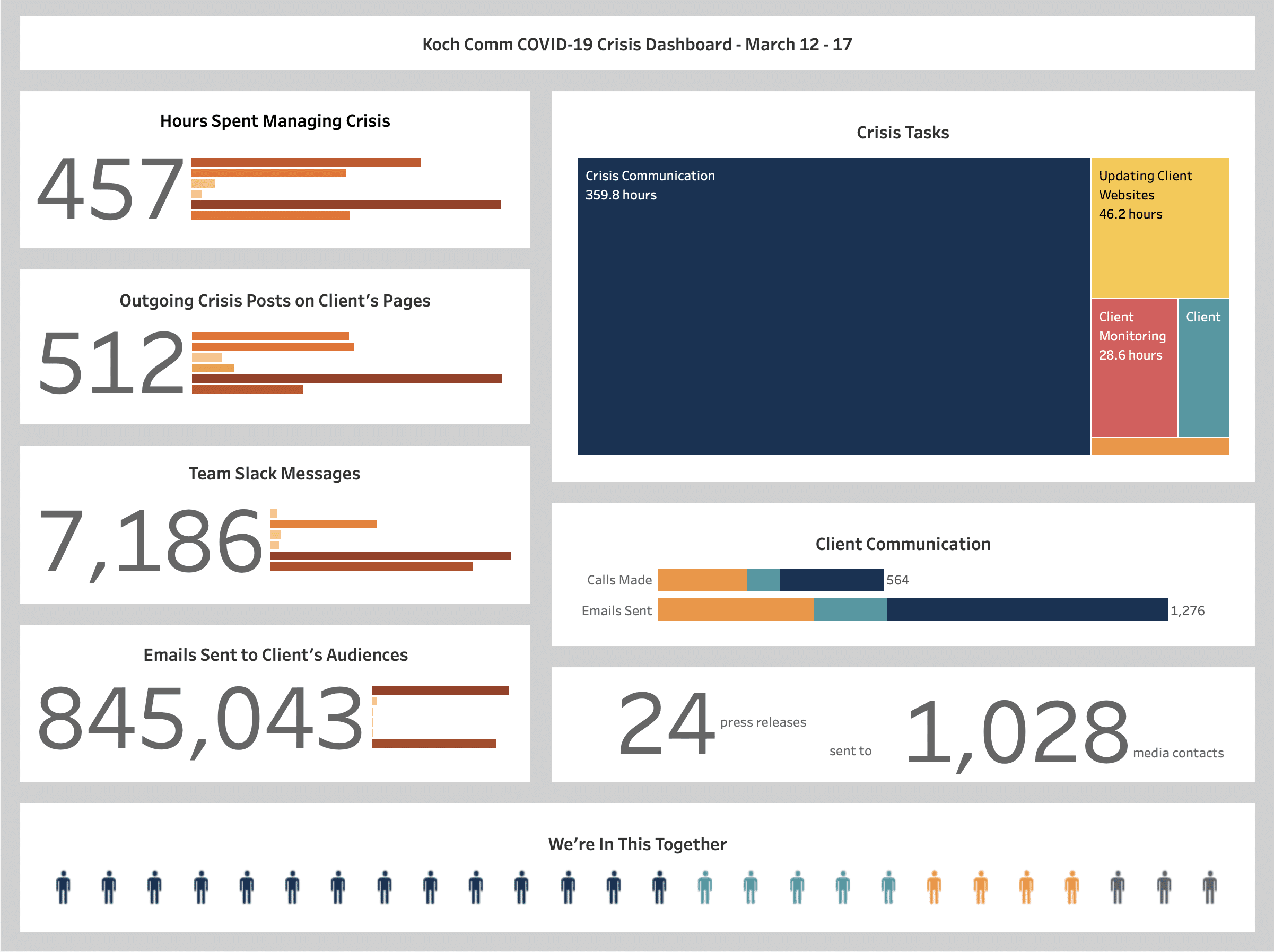
It was a whirlwind month for Koch Comm, as it led communications efforts for its dozens of clients in the entertainment space. Koch Comm sent hundreds of thousands of emails, dozens of media advisories, hundreds of social alerts and countless updates on home pages and FAQ pages for multiple clients.

The work was appreciated. They knew that. But when it’s measured, it’s more memorable. 

That’s where OROS Analytics came in. 

Koch Comm knew the goals. OROS measured the work. OROS told the data story.

Through the work of our powerful marketing intelligence team and platform, OROS told the story of the 86% positive sentiment. OROS told the story of the increase in click to open rates for entertainment cancellations vs. other updates.  Our visualizations showed in clear comparative detail the massive increase in engagement during different periods of time during the crisis. OROS told the story of large increase public relations impressions and thousands of media contacts.

OROS showed that it all happened in a matter of hours. 

“if you skipped the measurement…will your work be remembered?”

The COVID-19 crisis and the work marketers executed around the world were important to so many brands. But if you skipped the measurement because it wasn’t critically important to you at the time, will your work be remembered?

At OROS Analytics, we believe measuring your work and proving your value should be a top priority. 

STUFF FOR
HUMANS

Why we started OROS

“We’re cutting your marketing budget because times are tough, and we have to cut costs.”

-EVERY CFO EVER

So, we started a marketing analytics and intelligence company and you might be asking why. Chiefmartech.com tracks almost 7,000 marketing technology companies and there’s a decent-sized list of data and attribution companies within the portfolio. But hear us out, because we think we’ve built something special. 

Marketers have a positioning problem. We’ve spent late nights and early mornings pushing product, fighting for clicks, and slashing unsubscribe rates. We care about our products, and we believe that we’re making a difference. Our companies grow when we’re doing our best work. We know exactly who our customers are and what they want. We read blogs and listen to podcasts. We do our best to stay current with the latest trends.

In our effort to be the best marketers we could be, we completely overlooked the most important initiative in all of marketing… showing our value. As ironic as it is, we’ve ignored one of marketing’s sacred four Ps, and we find ourselves fighting just to keep our budgets flat. Marketing is viewed as a cost. A luxury of business which can be pulled at the first sign of a bad day on the Dow. 

But marketing isn’t a cost. It’s an investment. We spend money, results go up. We test to see what works and results go even higher. So, why do marketers struggle with the positioning of our value? Again, there are a lot of marketing analytics companies out there. We’ve tried them. We’ve entered our credit card number into those same 14-day trial agreements that you have. The problem is complex to solve, but easy to identify. Marketing intelligence has a lack of technology getting to the root of the problem, which leads to lost time and efficiency for humans to actually use the data to make data-driven decisions. 

We’re marketers, too. In our past lives, we ran our social media reports out of one of those great tools that let you publish, report, and monitor all in one fell swoop. We generated our email reports out of whichever ESP we were using, and we compiled it all with some Google Analytics and Google Ads dashboards. We took the spreadsheets from our paid media publishers, and we grabbed a .CSV from our POS or sales team to bookend the report. Before we knew it, we had 48-page reports with all sorts of disjointed metrics that were actually all interdependent, but the report didn’t show it. You know how this story ends. The data was too generic, and there was too much. What data was consumed by the end-user turned into a list of questions about the data itself, not the marketing story and ecosystem.

So, then we took a different approach. We started getting great metrics into Excel. Only the stuff we needed. But, we were spending 90% of our reporting time building reports and 10% analyzing them. Reports became a huge burden that was checked off our lists and then we moved on. No insights. No recommendations. No value shown to the people who cut our checks. What’s worse, we were only doing the “good” hand-built reports for our biggest budgets because they were so time-consuming. We were leaving other marketing programs with that big 48-pager.  

So we started OROS.

Because of our experiences, we know marketing analysis needs a human-centric approach to declutter data and make marketing analytics more approachable and full of impact. That’s what’s missing in the marketing data space. With most analytics products, you put your card in and never work with anyone unless you have a support ticket. You need a partner because you need to create customized reports that are different for each of your stakeholders. Your CEO’s marketing report should be different than the reports your strategy team uses to review, adjust and plan your marketing efforts.

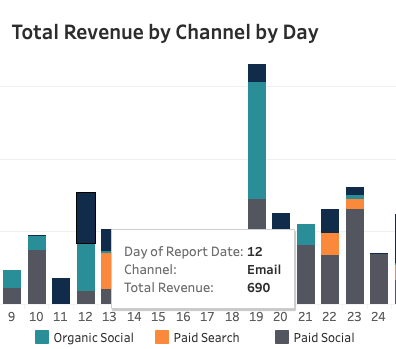
You need to see your paid Facebook impressions and your paid search impressions all on one trended line with revenue by day layered on top. You need to see not just how your channels impacted your website, but also how different messages drove success. You need reports showing how your campaigns are running, refreshing with new data so that your team can adjust strategy in real-time instead of waiting until after all that money was spent. You need all of your data filtered to show only the important metrics that are tied to your business drivers. Your reports should tell a story, with clarity, about how your marketing is growing your business. They should serve as a road map showing where you were and where you’re going. 

It takes humans who understand marketing and how to get your data centralized and visualized in one place. Our engineering and technology team members are former marketers. 

It takes humans to write your measurement strategy that fits hand-in-glove with your marketing strategy. It takes people who can show you how to track your marketing efforts and make sure they’re tied together (which has to happen before your marketing efforts go out the door). Our data collection team understands how marketing channels are intertwined. 

It takes humans who understand how to interpret and analyze data, derive intelligence and help forecast your predictive results after changes are made. Our insights team is built on marketing principles. Simply, it takes more than an out of the box solution. Built for marketers, by marketers, we’re a human-centric approach to data unification and visualization because you have to show your value.

Let’s talk.

Request a Demo